Learn How DevOps CI/CD & Analytics Reduce Deployment Failures
Many organizations are dealing with optional risks due to software deployment failures. According to CISQ, poor software quality costs the UN economy $2.41 trillion per annum, with high deployment failures accounting for a significant share of that figure. For technology leaders, this case is more than just a financial impact on the entire industry, but also includes competitive positioning, operational stability, and customer trust erosion. Furthermore, a failed launch or release delays or halts the timelines and risks customer dissatisfaction. Also, it includes revenue loss and stable operating cash flow burn, with a significant increase in recovery expenses and costs for the perfect procedure.
Nevertheless, if you want to bypass these complexities, we recommend enrolling in a DevOps course that covers the crucial fundamentals. Furthermore, the integration of DevOps methods with cutting-edge analytics has to a paradigm shift in how businesses approach software delivery. Today’s DevOps teams have fundamentally shifted and now experience fewer than 5% deployment failures. At the same time, it can recover from an incident in less than one hour and deploy several times/day while maintaining exceptional consistency. Well, these troubleshooting methods you will learn in your DevOps course online classes will definitely help you throughout your career.
In this comprehensive guide, we will explore how organizations are using DevOps techniques they have learned in their DevOps course phase, in conjunction with analytics-driven intelligence, to prevent deployment failures, create resilient software delivery pipelines, and optimize recovery time.
Why Do Deployment Failures Happen?
Deployment failures usually occur due to misconfigured environments, dependency mismatches, and manual process errors between testing and production. Moreover, the key causes of failures include inadequate testing, missing environment variables/secrets, and resource constraints. Standard release models and systems are highly prone to human error and operational delays. Thus, they are not appropriate for the fast-paced demands of today’s organizations, which are filled with top engineers who have earned DevOps course online certifications.
Financial Effect of Deployment Failures on Businesses
| Impact Category | Short-Term Financial Impact | Long-Term Financial Impact |
| Revenue Loss | Immediate drop in sales and transactions | Customer churn and reduced lifetime value |
| Incident Response Costs | Overtime pay, contractor fees | Increased operational budget allocation |
| Customer Compensation | Direct payouts and credits | Higher contractual obligations in future deals |
| Reputational Damage | Reduced new customer acquisition | Lower brand equity and pricing power |
| Productivity Loss | Idle employee time | Delayed product releases and opportunity costs |
| Compliance & Regulatory Fines | Immediate fines and legal costs | Increased audit scrutiny and compliance costs |
| Remediation & Rework | Development sprint disruptions | Higher technical debt and future maintenance costs |
| Infrastructure Waste | Cloud overage charges | Increased infrastructure optimization investment |
| Lost Competitive Advantage | Missed sales cycles | Long-term market position erosion |
How Does DevOps Address Deployment Failures?
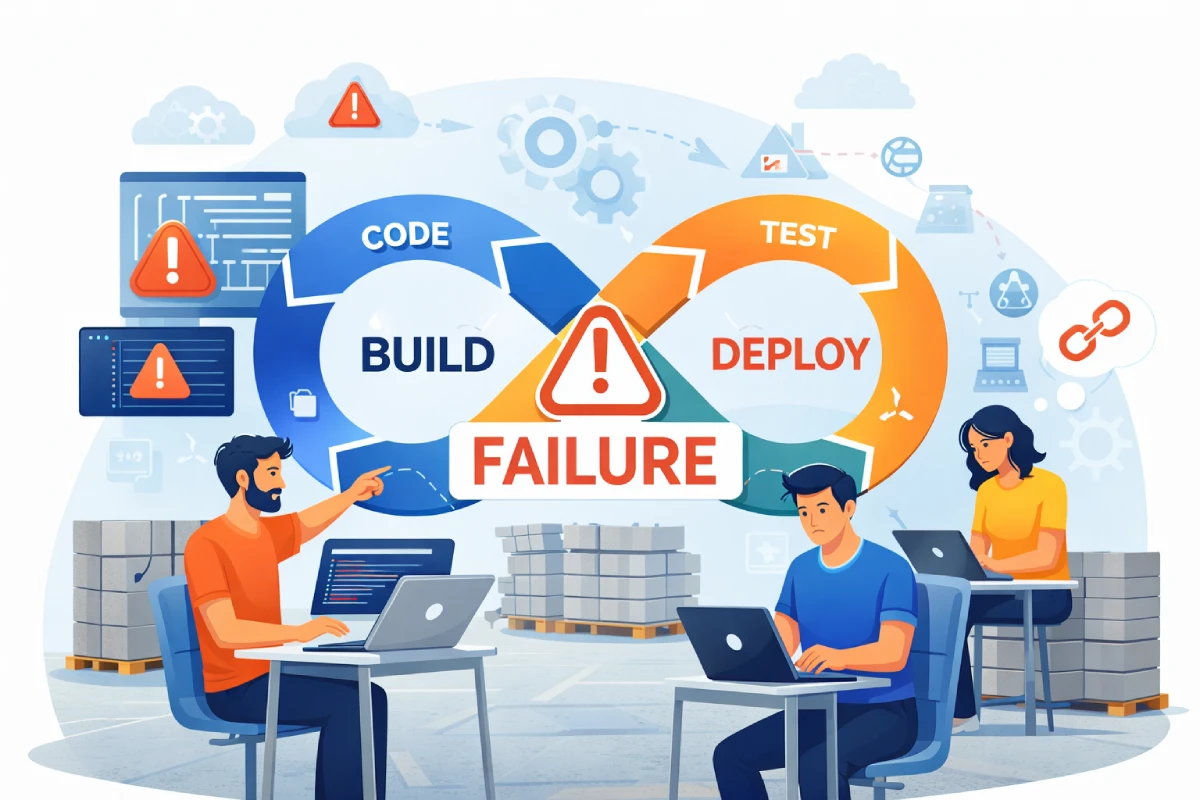
Deployment failures can be a tech team’s worst nightmare. Sometimes it is a server failure, sometimes a configuration problem, and sometimes a last-minute bug that brings the whole system down. Furthermore, it is where DevOps comes into play and turns the tables around. Therefore, it is one of the top reasons you must have a DevOps course online certification before starting your career in this precise field.
1. Early Bug Detection through Continuous Integration
CI tools automatically integrate and test code. When automated testing is performed with every commit, bugs are identified even before they enter production. That is why professionals prefer CI tools more when it comes to preventing deployment failures.
2. Automated Testing Reduces Deployment Risks
Manual testing is a time-consuming and unreliable process. Therefore, DevOps performs unit, integration, and regression testing quickly through automation, thus minimizing the risk of deployment failure.
3. Continuous Delivery and Continuous Deployment
CD methodologies ensure that code is always ready for deployment at all times. Smaller, more frequent releases spread risk and make rollbacks easier in case of deployment failures.
4. Alignment with Infrastructure as Code
Infrastructure-as-Code (IaC) tools such as Terraform and Ansible handle configuration as code. It eliminates the problem of environmental mismatch, which is a common cause of deployment failure in many cases.
5. Real-Time Monitoring and Logging
The monitoring tools help keep an eye on the health of the system. If there is some unusual activity observed after the deployment, the team can immediately act on it. The logs help with root cause analysis, making deployment failures easier to resolve.
6. Collaboration and Shared Responsibility
Right collaboration and sharing responsibility are among the things every professional has to learn in their DevOps course online, which will help them use these key factors when they face deployment failures. Likewise, the DevOps mindset helps eliminate silos between the development and operations teams. If both teams collaborate, there are fewer chances of miscommunication, and the deployment process becomes smooth.
7. Rollback and Blue-Green Deployments
The Blue-Green deployment method uses two identical environments. The new version is first deployed on the inactive environment. However, if something goes wrong, the traffic can be immediately routed to the older, stable version.
8. Proper Training and Upskilling
Currently, people are learning about some useful tools and pipelines by enrolling in the DevOps courses. Furthermore, the DevOps course teaches them to deal with real-world deployment scenarios. If the team is trained, the effect of failure will be less.
9. Standardized Processes and Documentation
The runbooks and step-by-step documentation help avoid confusion among the team members. If the deployment process is well-defined, new team members can handle it without confusion. Also, it helps a lot in controlling unexpected failures. A good DevOps mindset is proactive and helps with planning, making the deployment process predictable, stable, and reliable.
Concluding Here!
Integrating DevOps and analytics is not limited to a technological advancement. Furthermore, it is a strategic necessity for today’s business world. By proactively identifying and resolving issues, these methods ensure seamless deployments without failures, reduce downtime, and improve system reliability.
Moreover, we hope this comprehensive blog has provided you with all the details you need about the significant ways DevOps eliminates deployment failures. Nevertheless, if you are starting your career in this field, ensure to have a certification of DevOps course online from a reputable institute. Likewise, when it comes to a reputed institute, Rexton IT Solutions is your ideal place. We offer a wide range of courses that align with your career path and also provide a 100% placement guarantee. So, what’s stopping you from becoming the top name in the Engineering Field? Enroll with us today!
Frequently Asked Questions
DevOps utilizes CI/CD testing, pipelines, and monitoring to identify bugs early. Furthermore, it significantly reduces even the tiniest chances of deployment downtime and failure.
Of course! DevOps is not limited to large businesses. Small businesses can also implement DevOps easily using automation tools and cloud technology.
Analytics helps obtain real-time information to easily detect areas where the system might fail. Likewise, it enables proactive measures and reduces recovery time.
The skill of Devotional is in high demand currently. DevOps course certification will help you gain expertise and boost your chances of employment, particularly in the IT sector.