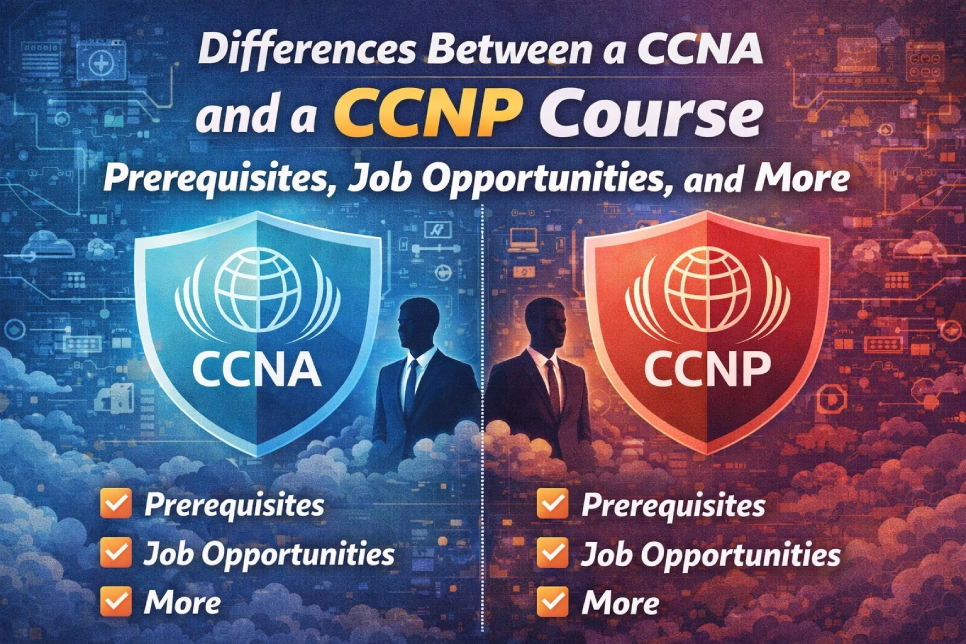
Differences Between a CCNA and a CCNP Course – Prerequisites, Job Opportunities, and More
CCNA and CCNP are highly recognized certifications offered by Cisco. These two certifications validate the candidate’s computer networking knowledge, covering essential foundation and advanced networking concepts. The fundamental difference between CCNA and CCNP certification is the depth of computer networking that they cover. While the CCNA certification validates entry-level skills, the CCNP certification demonstrates advanced-level skills. Thus, the CCNA and CCNP courses cover different topics, with the CCNP course delving deeper into enterprise-scale computer networking.
Learning the difference between the two courses is important to make the right career choice. Choosing a course that fits your career goals ensures a smoother path and helps you avoid diversions and doubts. The CCNA CCNP course is an excellent way to prepare for the certifications. In this blog, we will cover the key differences between these two courses to help you pick the right course.
What is CCNA, and What Do You Learn in a CCNA Course?
CCNA, or Cisco Certified Network Associate, is an entry-level networking certification. It validates your skills in installing, configuring, and maintaining small and medium-scale networks. Therefore, a CCNA course covers the basics and key fundamental concepts, including network components, IP addressing, security automation, and wireless basics. The goal of this course is to familiarize you with computer networking, introduce key concepts, and provide a brief overview of hands-on experience with modern tools.
What is CCNP, and What Do You Learn in a CCNP Course?
A CCNP, or Cisco Certified Network Professional, is a globally recognized computer networking certificate that proves your skill in handling complex networking problems. Most of the candidates seeking this certification already have jobs in IT or computer networking and are aiming for a higher position. Therefore, the CCNP course covers more advanced computer networking topics and focuses on building hands-on experience with networking software tools and applications. On top of that, complex networking topics such as OSPF, EIGRP, BGP for large-scale networks, switching, and advanced automation are also included.
Key Differences Between CCNA and CCNP Certification Courses
The following points will give you detailed differences between the CCNA CCNP course:
1. Target Candidates
The CCNA course is ideal for candidates who are complete beginners in computer networking or have a brief surface knowledge. This course includes fundamental topics that help candidates develop a familiarity with critical computer networking concepts. On the other hand, a CCNP course targets experienced computer networking professionals who are already familiar with computer networking concepts.
2. Knowledge Depth
CCNA courses only cover the surface of complex topics and only give you a glimpse of enterprise-level networking. But in CCNP courses, you become more familiar with complex computer networking problems and learn to design optimized solutions. A CCNP course will teach you how to configure and implement networking solutions at an enterprise scale.
3. Exam Difficulty Level
The CCNP certification exam is more difficult than the CCNA exam because it covers advanced topics. The CCNA exam is more beginner-friendly and considered moderately difficult, while the CCNP exam leans more to the technical side.
4. Job Opportunities and Pay Scale
The jobs after the CCNP course are limited in numbers, as it unlocks higher positions in the hierarchy. You might also face more intense competition for jobs after the CCNP training. But you will also get significantly higher pay and more solid job security.
5. Prerequisites
There are no formal or academic prerequisites to enroll in the CCNA CCNP course. Whether you have an IT or a non-IT background, you can enroll in either of these courses. However, candidates who want to enroll in the CCNP course must have a fundamental knowledge of computer networks. Gaining CCNA-level education is highly recommended before enrolling in this course. But you can still enroll in a CCNA course even if you’re a complete beginner in computer networks.
Professional Counselling by Rexton IT Solutions
At Rexton IT Solutions, we offer more than the best CCNP course. Here, our goal is to provide candidates with a platform that offers comprehensive learning and job opportunities. Our experts prepare you for the modern job world with practical training, hands-on experience, and mock interviews. Consequently, you won’t have to spend a considerable amount of time on job preparation after the course. This saves you a lot of time and allows you to apply for jobs with a strong resume.
The professional career counselling at Rexton IT Solutions helps you choose the best career option according to your skills and future goals. On top of that, our experts will design a personalized roadmap to ensure a smoother transition in your career.
Searching for a CCNA course near me? Rexton IT Solutions brings you the right solution! Register today or contact us for more information.
FAQs
To get the best results out of the CCNP course, first and foremost, you will need a strong foundation. Develop strong basics and keep on revising them. Keep working on real-world projects and try to use as many modern, in-demand tools as possible. Also, keep yourself up to date on any developments on the Cisco platform so you have the right resources.
Here are the reasons to choose an experienced course provider:
- Expert trainers with real-world networking experience
- Structured course aligned with Cisco Certified Network Professional (CCNP) exam objectives
- Updated curriculum based on standards from Cisco Systems
- Better hands-on lab practice and real network simulations
- Focused preparation for certification exams.
The CCNA CCNP course by Rexton IT Solutions offers all the above-mentioned benefits, along with transparent course pricing.
No, you do not need to have a CCNA certification to either take the CCNP exam or to enroll in the course. However, having CCNA-level computer networking knowledge can significantly benefit you and improve your learning curve.
Information on the CCNP exam:
- Core exam tests enterprise networking fundamentals and advanced technologies
- Concentration exam focuses on a specific area, like security, automation, or advanced routing
- Exam questions include multiple-choice, drag-and-drop, and simulation-based tasks
- Exam duration is typically around 120 minutes.
No, the CCNP certification is only valid for 3 years after issuance. Therefore, you must renew your certificate before the expiry date to avoid reapplying for the whole certification exam process.
Contact us to know the detailed procedure for certificate renewal!