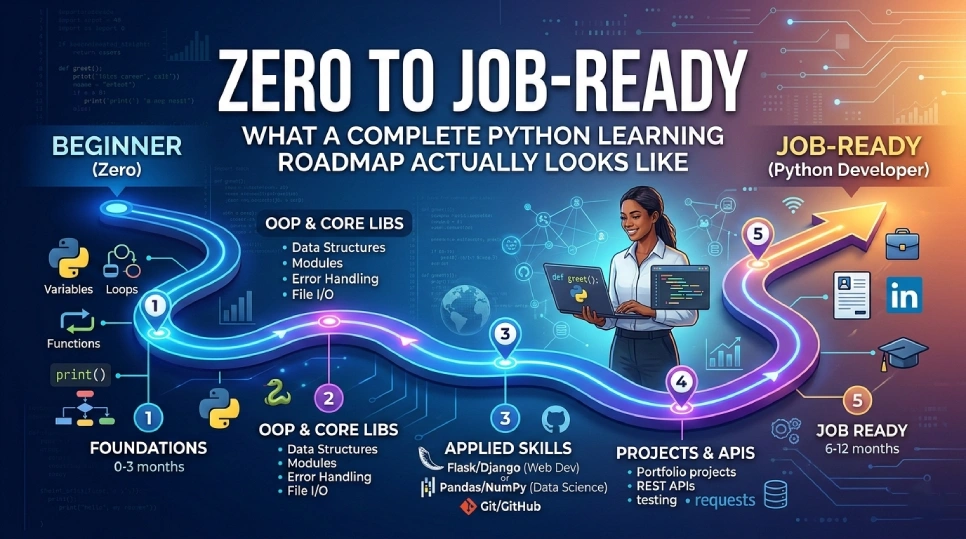
Zero to Job-Ready: What a Complete Python Learning Roadmap Actually Looks Like
Did you Google “learn Python” and end up with 50 open tabs, 12 YouTube playlists, and three contradictory Reddit threads? It’s time to enroll in the Python course in Delhi. You must be thinking: why opt for courses when you can learn from free resources on your own? That’s the problem, most often beginners make many mistakes that cost them months. Guidance and structured learning are the most important things you need to consider before making up your mind to learn any skills. Taking a course from a recognised institution helps you in many ways. More importantly, it will enhance your learning.
Beginners without guidance make mistakes by jumping into advanced topics too fast and then quitting. Or spend months on basics without ever building anything real, without knowing what a job-ready actually means in the current market. Therefore, the Python course in Delhi can help you build a great career only if you learn it with professional guidance. This blog explores the complete Python learning roadmap, so dive into it.
The Foundation Phase (Week 1-8): The Most Critical Phase in Learning
The foundation of any skill is most critical, as it builds your muscle memory and helps you understand advanced topics effectively. At this phase, you start to become familiar with the language and learn about the scripts, syntax, and patterns. What is learned now will be essential for future developments. The Python classes in Delhi can tell you specifically what to focus on more and remember for future topics. While some basics can be learned and understood, they don’t require much attention. Having a mentor can make things better. Here are the 5 milestones you must conquer before calling yourself Intermediate.
- Logic & Syntax Fluency: Learn about topics, such as variables, data types, and control flow. Then use this to build a calculator and number-guessing game.
- Object-Oriented Thinking: It involvesClasses, inheritance, encapsulation, polymorphism, and Abstraction. After this, build a library management system.
- Data Handling: CSV/ JSON parsing, file operations, working with APIs, and then building a contact importer.
- Defensive Programming: Exception handling, input validation, and debugging techniques.
- Tool Proficiency: Git version control, virtual environments, VS Code shortcuts.
A quality Python coaching program doesn’t just teach you syntax. It forces you to solve problems independently, so by week 8 you should be able to debug code without watching tutorials. Or asking for help to write a complex line of code or find a hidden bug.
Career Phase (Weeks 9-24): Timeframe To Prepare For Job
Unlike a student from a Python training institute Delhi, you need to look for job opportunities yourself. After learning, honing skills, and making some projects. You have done your part in training yourself and teaching, and practiced hands-on learning through projects. It’s time to target your dream job or dream company. Set a goal for all of this and start preparing. Yes, even finding a job requires weeks and months of strategic planning and applying. With the integration of AI, employers have become more specific and choosy about the people they hire.
Therefore, you need to plan strategically without any placement support, like Python coaching in Delhi. It’s the requirement to land a job faster, but before anything else, keep a clear idea of the job roles you’re aiming for. Ensure your projects align with your job requirements. Check out the table below to know your three paths that will lead you towards your first paycheck.
| Specialization Track | Weeks 9–14 (Skill Acquisition) | Weeks 15–20 (Portfolio Projects) | Weeks 21–24 (Interview Prep) |
| Web Development | Django/Flask, REST APIs, SQL databases, authentication | E-commerce site, Task manager with user login, API integration project | System design basics, SQL optimization, deployment on AWS/Heroku |
| Data Science & Analytics | Pandas, NumPy, Matplotlib, statistical analysis, data cleaning | Delhi air quality dashboard, Sales forecasting model, Web scraper for market research | Case study walkthroughs, A/B testing questions, portfolio presentation |
| Automation & Scripting | Selenium, BeautifulSoup, OpenPyXL, scheduling (cron), email automation | Automated job application tracker, Price monitoring bot, Report generator for Excel | Process optimization scenarios, debugging legacy code, and automation ROI calculation |
Concluding Note!
The focus and structured 6-month learning beats the two-year-long efforts. Therefore, this is your chance to get a Python course in Delhi, so you can get the job you dreamt of quickly. Through structured learning at an institute, you will not just collect certificates but also have many deployed projects. Projects that are a gateway to breaking into tech and showcase live proof of your skills to employers. Anyhow, try not to get overwhelmed with resources. Pick a handful and start with this. For more efficiency, you can also use the roadmap here.
Whether you follow this road, take a solo, or join a structured Python course in Delhi. Remember that consistency beats intensity. Don’t let your future self wait. Start today, as your future self will thank you for this while debugging code in a real office. As for the institution, check out the course at Rexton IT Solutions. We are a renowned institution offering a wide range of courses.
FAQs
Most beginners achieve job readiness in a year with consistent daily practice. However, a structured Python course with expert mentorship can accelerate this timeline through guided projects and real-world applications.
Yes. Python alone opens the door to many jobs, and it’s even becoming the base for learning AI/ML. So, even in the future, you can combine this with other skills, like web development or data analysis, making you truly hireable.
Yes, we provide morning, evening, and weekend batches specifically designed for working professionals and college students.
We emphasize live coding sessions and immediate resolution of doubts, including 1–on-1 mentor sessions, rather than passive video lectures.