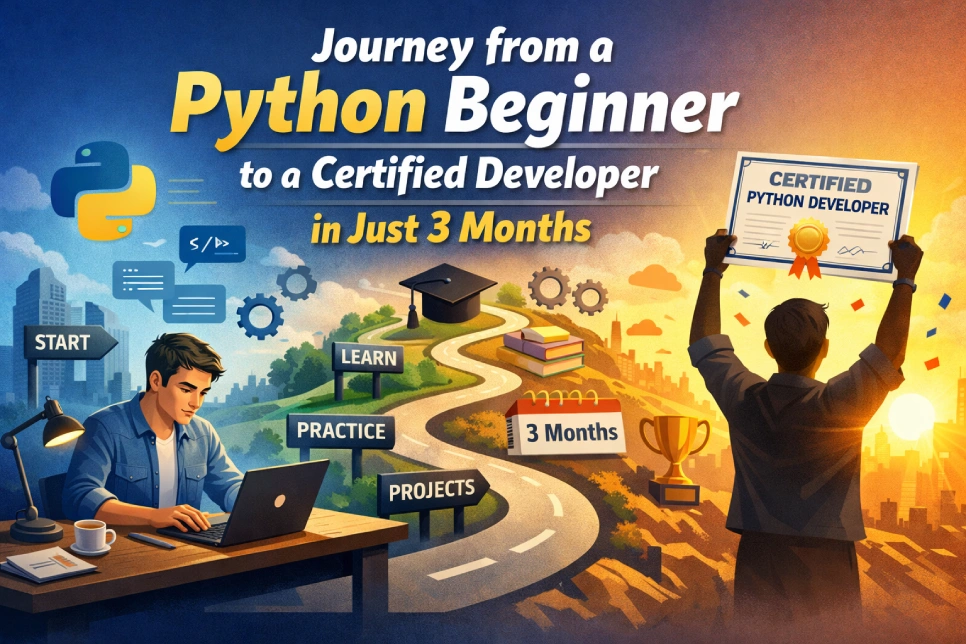
Journey from a Python Beginner to a Certified Developer in Just 3 Months
Don’t be surprised. You can become a certified developer in just 3 months. You’ll need to gain fundamental skills, consider a Python course in Noida, and have a keen understanding of Python’s tools, foundation, and realm. If you want to build your career as a Python Developer in a reputed organization in a short time, you need to walk on the right roadmap. Learning Python and its extensive libraries and frameworks, taking live sessions, clearing your doubts with Python tutors, and communicating with professional tech pros can help you make the right decisions and obtain certified Python training in Noida.
Furthermore, the Python learning journey will not be easy, but it will definitely be worth it. With consistency, passion, and a clear path, you can build a successful career. In this blog post, we will discuss a results-oriented roadmap for becoming a Python developer in just 3 months with consistency and an active mindset.
What is a Python Developer?
A Python developer is a software engineer who uses Python to design, build, and deploy applications, concentrating on backend services, AI, data analysis, and automation. They build reusable code, handle data structures, and work efficiently with frameworks to connect user-facing components to server-side logic.
Unlike some career pathways, those who meet the needs of the Python Developer role after completing their Python course in Noida often receive alternative titles, such as Back-end Developer, Web Developer, and Database Engineer. Thus, while most of these tech professionals know tools, such as SQL, AI, Git, Django, and Flask, not all Python Developer positions need the same skill set.
Are You Ready to Become A Certified Python Developer in Just 3 Months?
Many individuals think that learning programming languages or opting for a Python or data analytics course in Noida takes years. However, if you follow a precise, structured roadmap and stay consistent, you can build a robust foundation in Python development in just three months. That is why we have curated this month-by-month roadmap to provide a clear picture and path from a Python beginner to a job-ready developer in just three months.
Month 1: Python Basics and Programming Foundation
This is arguably the most significant month, as it’s when you lay the foundations for programming. It is imperative that you understand these basic Python concepts with the right Python or any other data science course Noida, as this will enable you to easily grasp other complex concepts later on. The aim of this month is to lay the foundations of programming logic.
Moreover, programming may seem a little confusing at first, but once you start coding, you will realize that everything starts making sense. The emphasis of this month should not only be on theory but also on practicals, as this will enable you to gain confidence.
Topics you will learn in the first month of Python training in Noida:
- Python installation and development environment setup
- Variables and basic data types (integers, floats, strings)
- Data structures like lists, tuples, sets, and dictionaries
- Conditional statements like if-else
- Loops – for loop and while loop
- Functions and the concept of reusable code
- Basic error handling and debugging
Building small projects is essential in understanding concepts, as practical work provides real learning.
Here, we have mentioned some projects you can work on in the first month to test your learning skills after completing the first phase of the Python course in Noida:
- Simple Calculator Program
- Number Guessing Game
- Command-Line To-Do List Manager
- Random Password Generator
Month 2: Real-World Python Development
As you study Python consistently, learning will become more interesting in the next phase as you start to use Python in real-world project applications. Once the basics are clear and concise, the next step in the Python course in Noida is to structure the code and create real software components. In the second month, the main focus is on Object-Oriented Programming (OOP) and practical programming development. Understanding OOP is crucial as it is used in almost every large-scale application.
In this phase, you start using Python to manage data, use APIs, and build simple web applications. Nevertheless, this stage provides newcomers with an experience of the actual development world.
Topics you will learn in the second month of the Python or data science course Noida:
- Object-Oriented Programming (Classes and Objects)
- Inheritance, Encapsulation, and Polymorphism
- File Handling – Reading and Writing Files
- Handling JSON and CSV Data
- Using Python Modules and External Libraries
- Introduction to the Flask Framework
- Fetching Data from APIs
- Basic Database Integration (SQLite)
It is vital to work on some real-world projects after understanding the Python concepts. Also, these projects are useful for your portfolio.
Check out the real-world projects to create a strong portfolio:
- Student Management System
- Personal Expense Tracker
- Weather Application Using API
- Simple Blog Website Using Flask
Month 3: Advanced Tools and Modern Developer Workflow
The third month is entirely focused on professional moves beyond coding to development tools and workflows. When it comes to the real world of development, it is not limited to programming. Python developers should also know how to handle, test, and deploy code. At the third stage, you will learn the tools that professional developers use daily. These programming tools make you industry-ready and make your real-world projects more organized and reliable. Python developers learn to use Git and GitHub for version control. Likewise, it allows you to track your code and align with your development team.
Core topics you will learn in the third month of the Python course in Noida:
- Git and GitHub basics
- Version control and code collaboration
- Virtual environments (venv) and dependency management
- Unit testing and PyTest basics
- Python automation scripts
- Web scraping techniques
- Application deployment basics
In this third and final stage, you need to focus on building one or two main portfolio projects that clearly showcase your skills in the real-world.
Here are some advanced-level real-world project ideas that you can opt for to build a solid portfolio:
- Full-Stack Flask Web Application
- Python Automation Tool For Daily Tasks
- Web Scraping Project with Data Storage
- Rest Api-Based Application
Check Point of Rexton IT Solutions’ Certified Python Course Outline
At Rexton IT Solutions, our learning platform not only offers theoretical knowledge but also practical experience. Students can learn to code with practical experience. Additionally, we have mentioned an end-to-end syllabus of the Python course in Noida:
Module 1: Introduction to Python, Overview of Python and its applications, Features and advantages of Python, Installing Python and setting up the environment, and Running Python programs (Interactive & Script mode)
Module 2: Python Basics, Python syntax and code structure, Variables and data types, Input and output operations, Type casting, and Operators (arithmetic, comparison, logical)
Module 3: Control Flow Statements, Conditional statements (if, elif, else), Loops (for, while), Loop control statements (break, continue, pass), and Nested loops and logical flow design
Module 4: Data Structures in Python, Lists (creation, indexing, slicing, methods), Tuples and immutability, Sets and set operations, Dictionaries and key–value pairs, and Data manipulation examples
Module 5: Functions and Recursion, Defining and calling functions, Function parameters and return values, Default and keyword arguments, Recursive functions, and Local vs global variables
Module 6: Object-Oriented Programming (OOP), Classes and objects, Constructors and instance variables, Inheritance, Polymorphism, and Encapsulation and abstraction
Module 7: Exception Handling, Understanding runtime errors, try, except, else, finally, Handling multiple exceptions, Creating custom exceptions, and Error-handling best practices
Module 8: File Handling, Reading and writing files, File modes and file pointers, Working with CSV files, Context manager (with statement), and File handling best practices
Module 9: Modules and Packages, Built-in modules, Creating user-defined modules, Installing packages using pip, Package structure, and Virtual environments
Module 10: Python for Automation / Scripting, Automating repetitive tasks, File and folder automation, Using OS and system commands, Basic web automation, and Real-world scripting use cases
Module 11: Working with Databases (SQL), Database fundamentals, Connecting Python with databases, CRUD operations (Create, Read, Update, Delete), Executing SQL queries in Python, and Database exception handling
Module 12: Regular Expressions, Pattern matching, Searching and replacing text, Regex syntax and patterns, and Text-processing examples
Module 13: GUI Programming (Tkinter), GUI basics, Creating windows, buttons, labels, Event handling, Layout management, and Building simple desktop apps
Module 14: Data Analysis with Python, Data analysis workflow, Working with arrays and dataframes, Data cleaning and transformation, Basic visualization, and Introduction to data libraries
Module 15: Introduction to Machine Learning, Basics of machine learning, Types of ML, ML workflow, Data preparation, and implementing simple ML models
Module 16: Testing and Debugging, Debugging techniques, Logging and debugging tools, Writing unit tests, Common bugs and fixes, and Improving code reliability
Module 17: Final Project, End-to-end Python project, Requirement analysis, Coding and testing, Optimization, and Project presentation
Concluding Here!
If you are new to Python training, you might be interested in starting your Python journey with Rexton IT Solutions’ Python course in Noida. We are the leading and most trusted Python course provider in Noida, offering a perfect balance between theory and practice. In this course, we covers fundaments before taking candidates through in-demand tools, such as SQL, Git, and Django REST.
We are the best Python course provider in Noida that also offers candidates job security through our 100% placement drives. Hence, we assure that Rexton IT Solutions will surely help candidates kick-start their careers on a high note. Enroll now!
Frequently Asked Questions
After learning Python, you can apply for a job as a Python developer, data analyst, automation engineer, web developer, or machine learning engineer. The opportunities are wide because Python can be used in many industries.
This type of learning involves learning Python, as well as essential tools and technologies such as Git, GitHub, SQL, APIs, the Flask framework, and automation tools.
Yes, daily coding is essential for learning Python. This is because, with daily coding, you can understand Python concepts very fast.
No, Python is one of the easiest programming languages in the world for a beginner to learn, as its syntax is easy to read.