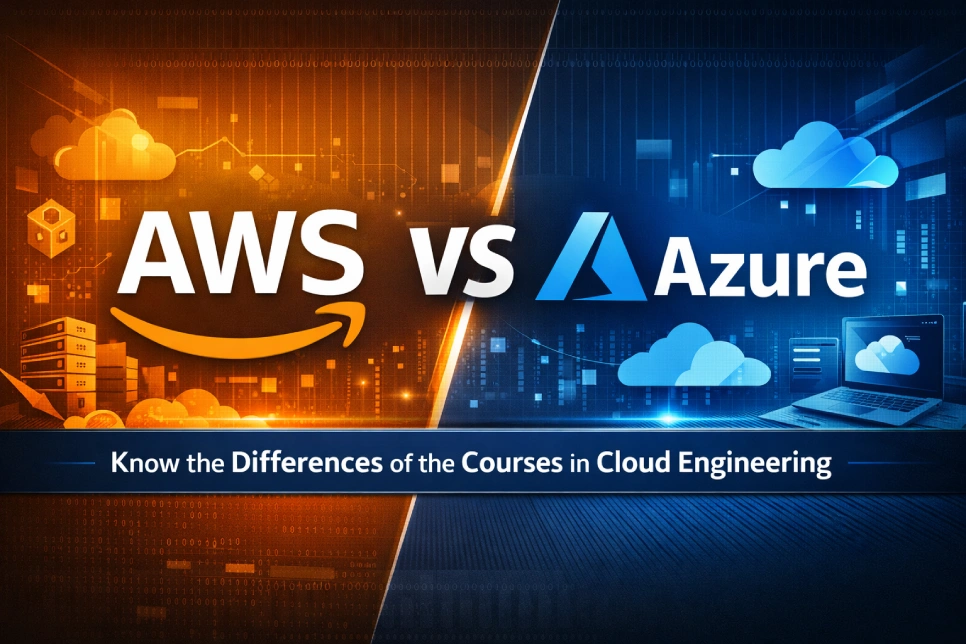
AWS VS Azure | Know the Differences of the Courses in Cloud Engineering
Cloud computing platforms are creating more jobs than ever in tech, with increasing demand for cloud engineer courses. Cloud computing is a gateway for professionals to enter this domain and build expertise in it. All data from big tech companies is now stored in the cloud, making this sector famous and competitive. In the market of cloud computing, we have two very well-known brands that host almost all the data out there. Amazon Web Services (AWS) and Microsoft Azure are two competing cloud hosting services. While both offer structured learning paths, their focus areas, certifications, and career opportunities differ significantly. Learning them with proper understanding can enhance the learning path.
In this blog, we will discuss how enrolling in cloud engineer courses can help you elevate your career journey. Additionally, we will compare the two courses, one from Amazon and one from Microsoft. How does industry adapt both of these, and which one should you learn based on your job choices and targeting companies? This guide will help you clear any doubts you have about cloud computing, its cloud services, and its market leadership.
Difference Between AWS and Azure Cloud Computing Courses
While both AWS and Microsoft Azure are cloud computing services. Both these are demanded by different enterprises and industries based on their preferences and workforce ecosystem. The cloud engineer courses differ in various aspects. They vary in their global opportunities, scalability, innovation, hybrid cloud, AI Integration, and heavy ecosystem. However, many professionals pursue both certifications over time to maximize flexibility and career growth, but that’s a discussion for another time. Here is a table that covers all aspects in a simplified way to help professionals make better decisions.
| Aspect | AWS | Azure |
| Market Share (2026) | ~30% of the global cloud market, leading provider | ~20% of global cloud market, strong enterprise/government adoption |
| Certification Levels | Foundational → Associate → Professional → Specialty | Fundamentals → Associate → Expert → Specialty |
| Focus Areas | Compute (EC2), Storage (S3), Networking (VPC), DevOps, Security | Hybrid cloud, AI/ML integration, Microsoft ecosystem (Active Directory, Office 365) |
| Exam Structure | Scenario-based, multiple-choice, labs (depending on level) | Case studies, multiple-choice, role-based exams |
| Industry Demand | Popular among startups, tech firms, and global enterprises | Strong demand in government, finance, healthcare, and Microsoft-heavy organizations |
| Career Opportunities | Cloud Architect, DevOps Engineer, Solutions Architect, Security Specialist | Cloud Administrator, AI Engineer, Azure Solutions Architect, Data Engineer |
| Salary Insights (2026) | AWS-certified professionals often command slightly higher salaries due to market dominance. | Azure-certified professionals remain highly competitive, especially in enterprise roles. |
How to Decide: Choosing the Right Cloud Engineering Courses
The choice of which cloud engineer courses to take can be effectively decided by considering several factors. They help you clarify the objective for doing the course and make the best decision based on your needs or goals. The clear choice is to state the more benefits you have while pursuing the courses.
1. Career Goals & Industry Alignment
The AWS certification course is best suited for professionals aiming to work in start-ups, tech companies, or global enterprises with diverse cloud needs. Meanwhile, the Azure cloud platform is well-suited for professionals targeting enterprise IT, government, finance, or healthcare. Where Microsoft integration in the system and other work is dominant.
2. Existing Skill Set and Ecosystem Familiarity
The choice can also differ with the skill family you already have. If you have previous experience with any Microsoft tools. Like Office 365, Active Directory, and Dynamics. Then the Azure courses will feel more natural to you, and you will also be able to learn and grasp the concepts more easily.
However, if you’re familiar with open-source tools, Linux, or containerization, AWS cloud engineer courses will be more suitable for you. Having prior knowledge or familiarity with any ecosystem helps learn the topic better.
3. Learning Style and Course Structure
AWS courses offer scenario-based labs and problem-solving learning methods. The Azure courses focus on the role-based certification with case studies and enterprise workflows.
4. Market Demand and Salary Trends
The market demand for AWS-certified engineers is slightly higher due to the company’s global reach and dominance. On the other hand, the Azure-certified engineers remain highly competitive across enterprises and in Microsoft-centric organizations.
5. Long-Term Strategy
Many professionals start with one course but eventually pursue both cloud engineer courses certifications to maximize opportunities in the market and flexibility. A dual certification offers you a versatile career path, opening opportunities to work across many industries.
6. Regional & Employer Preferences
Based on area and industry dominance and presence in those cities and areas, the demand can vary. Therefore, checking local job postings is recommended to understand the requirements for cloud skills in your region. In tech hubs, AWS certification dominates. However, in enterprise-heavy regions, Azure software leads often.
It’s Time To Wrap Things Up!
Doing a course that is going to be market-relevant in the time of layoffs is actually the smartest decision. Moreover, the cloud engineer courses came out as the best in such cases. As data is an asset for every big to small enterprise, managing and protecting it is vital at all costs. Therefore, companies will seek more cloud engineers in the future. These will increase the number of job openings with well-paid salaries and facilities. Anyone starting a career or planning a career switch, this is the right time with the right courses in your hands.
Enroll in Rexton IT Solutions’ cloud engineer courses. We offer many cloud engineering courses from AWS, Azure, and GCP. We cover it all, with the best instructor and the best module professional. Our institutes also facilitate advanced learning through hands-on lab projects, one-on-one doubt sessions, and flexible class schedules.
FAQs
Yes, Google also has its own Google Cloud computing platform, heavily focused on data analytics, A/ML, and Kubernetes. In this, the Associate Cloud Engineer certification is the entry point.
The demand for GCP cloud engineers is rising in the market. Employers look for individuals with multi-skilled abilities, making GCP certifications a highly competitive edge alongside AWS and Azure in the job market.
Yes. GCP courses are beneficial because they offer expertise in AI, big data, and cloud infrastructure. Certifications like a professional Cloud Architect rank among the top IT credentials, ensuring strong career growth and future security.
Yes. Rexton offers full placement support, including counselling, interview-readiness sessions, and placement assistance. We ensure to help students transition smoothly into cloud computing roles.
The courses allowed any individual to enroll as long as they wanted to learn. From freshers, IT professionals, Career switchers, entrepreneurs, and even those from non-IT backgrounds, to enter cloud computing.