TCP/IP vs. OSI Model | Internal Understanding of CCNA Network Communication
In the extensive and intricate world of technologies and computer networking, comprehending foundational models is vital. TCP/IP and OSI are the foundational protocols for communication in contemporary networks. Anyone enrolling in the Cisco CCNA course must understand that these models are not optional. It is essential for brainstorming in the networking field. Both models help explain how network protocols interact and function correctly. Thus, they have different structures, applications, and origins, which makes troubleshooting a network issue more interesting.
Furthermore, understanding these key differences is essential for mastering networking from basic to advanced levels. Likewise, when you enter the vast world of networking through the CCNA networking course, you will know how these models simplify complicated processes while reflecting how devices communicate step by step. Without a basic understanding of TCP/IP and the OSI model, your progress will be limited.
In this guide, we will discuss the layers of real-world applications and the roles of these models in a practical, easy-to-follow way. Let’s get one step closer to setting up your successful career with the right knowledge that you will learn in Cisco CCNA certification training.
What is the TCP/IP Model?
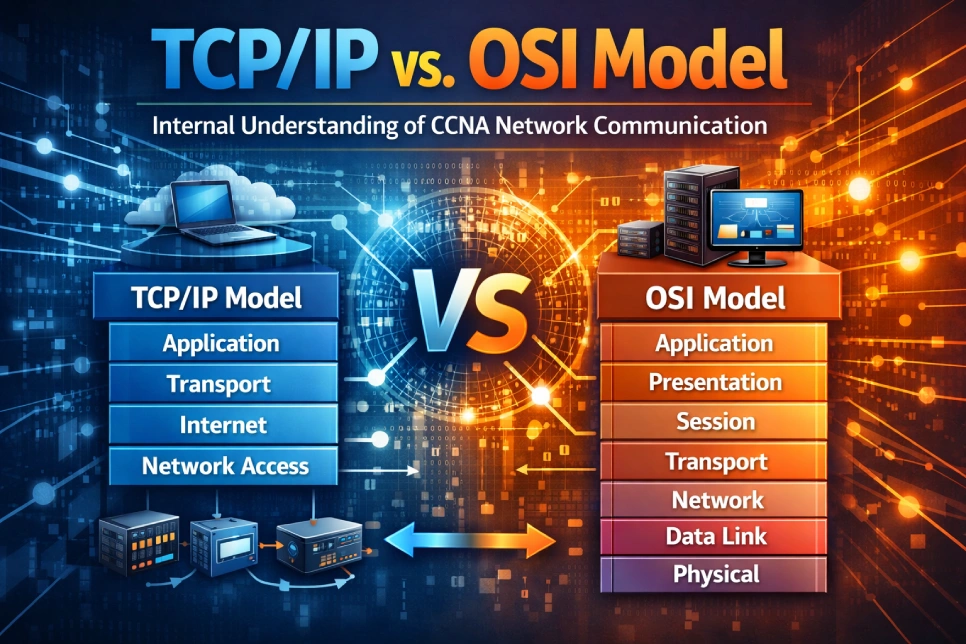
The TCP/IP model stands for Transmission Control Protocol/Internet Protocol, a suite of communication protocols used to connect network devices on the Internet. Furthermore, TCP/IP is a set of communication protocols used in private computer networks, including extranets and intranets. It is the four-layer, foundational conceptual structure that explains how data is transmitted across the Internet and other networks. Therefore, these models were developed by the U.S. Department of Defense in the 1970s and remain discussed in the Cisco CCNA course worldwide. Likewise, it standardizes rules for addressing, transmitting, packing, and routing data, enabling a wide platform for devices to communicate.
The Four Fundamental Layers of the TCP/IP Model
Let’s discuss the four significant layers of the TCP/IP model that will be beneficial for your Cisco CCNA certification training:
1. Network Access Layer (or Data Link Layer / Link Layer)
It is the lowest layer in the TCP/IP model. It combines with OSI’s Data Link and Physical layers to manage physical data transmission, hardware-level addressing, and framing. It handles node-to-node communication over local media (Ethernet, Wi-Fi) using MAC addresses to deliver vital data to adjacent devices.
2. Internet Layer (or Network Layer)
It is responsible for logical routing, addressing, and transmitting data packets across interconnected networks. When you enroll in the CCNA networking course, you will understand how it facilitates end-to-end communication by determining the best way for data, using the proper instructions, such as IP (Internet Protocol), ARP, and ICMP, to move data between networks.
3. Transport Layer
When you indulge in the Cisco CCNA course, you will come to know that the transport layer ensures trustworthy, end-to-end data delivery between applications on multiple hosts by structuring data, error retrieval, handling flow management, and using port numbers for multiplexing. Thus, it supports connection-oriented (TCP) and connectionless (UDP) services, serving as the interface between the lower network layers and upper application layers.
4. Application Layer
It is the top-most layer in the OSI and TCP/IP models, providing a direct interface between end-user applications (email clients, browsers) and the network. Furthermore, it also enables network services, such as DNS, SMTP, HTTP, and FTP, facilitating data communication, file transfers, and user authentication.
What is the OSI Model?
The Open Systems Interconnection (OSI) model is an abstract seven-layer structure developed by the International Organization for Standardization (ISO) that defines how network communication works in a universal language. Additionally, it enables diverse technologies to troubleshoot, communicate, and interact with every layer from layer 1 to layer 7. Likewise, it helps manage specific data transmission tasks.
The Seven Vital Layers of the OSI Model
Before signing up for the Cisco CCNA course, ensure you have a basic understanding of the seven fundamental layers of the OSI model, which will help you understand technical terms more effectively.
1. Physical Layer
It handles the raw transmission of bits (0s and 1s) over a physical medium and defines the electrical, mechanical, and procedural specifications for interconnecting devices, including connectors, voltages, data rates, and cables. Thus, it is essential data that underpins network communication. It transforms data from the Data Link Layer into signals for fiber-optic, wired, or radio links, and vice versa, ensuring that bits are transmitted from one node to the next without altering their original meaning.
2. Data Link Layer
This model provides reliable node-to-node data transmission by organizing bits from the Physical Layer into frames, managing error detection, physical addressing, and flow control for local network delivery. It performs essential transformations on a raw link to produce an error-free link for the end-to-end Network Layer. Hence, it’s divided into two sublayers: LLC (Logical Link Control) and MAC (Media Access Control).
3. Network Layer
It handles logical addressing (such as IP addresses), routes data packets across multiple networks, and acts as the Internet’s GPS for data using protocols such as ICMP and IP. Nevertheless, it breaks down more extensive details into packets and reassembles them at the receiving end, handling traffic flow and congestion across interconnected networks.
4. Transport Layer
It provides reliable, end-to-end communication between applications on different hosts, handling data flow, error correction, and ensuring delivery order. It receives data segments from upper layers, passes them to the network layer, and ensures delivery. Furthermore, it uses port numbers or process-to-process delivery and instructions, such as TCP (reliable) and UDP (faster, lower overhead), to provide multiple services, acting as a fundamental bridge between the network layers and applications.
5. Session Layer
This precise model establishes, manages, synchronizes, and terminates communication sessions between applications across multiple devices, serving as a meeting moderator. Therefore, it handles dialogue, delivers key pointers for data recovery when connections drop (such as resuming file transfers), and ensures orderly data exchange, bridging the Transport and Application layers for smooth, layered communication.
6. Presentation Layer
The Presentation Layer in the OSI model acts as the fundamental data translator, ensuring that data from one device’s application layer is readable by another’s by managing the structuring, decryption, compression, and encryption. Thus, it allows diverse applications to be in touch with one another seamlessly. Moreover, it bridges the gap between application-specific data and the network, converting between different syntaxes (such as ASCII and EBCDIC) and formats (such as MPEG and JPEG) for accurate presentation.
7. Application Layer
It is a top-layer protocol in the OSI model. Thus, it provides the interface for end-user applications (such as email clients and browsers) to access network services. Additionally, it enables key functions such as web browsing (HTTP), file transfer (FTP), and email (SMTP) by following specific instructions and ensuring data is presented in a usable format for all users. Likewise, it is the layer closest to the user, managing communication between the network and software.
Basic Comparison Table of TCP/IP vs. OSI Model
| Feature | TCP/IP Model | OSI Model |
| Full Form | Transmission Control Protocol / Internet Protocol | Open Systems Interconnection |
| Developed By | U.S. Department of Defense (DARPA) | ISO (International Organization for Standardization) |
| Number of Layers | 4 Layers | 7 Layers |
| Layer Names | Application, Transport, Internet, Network Access | Application, Presentation, Session, Transport, Network, Data Link, Physical |
| Primary Purpose | Practical implementation for real networks | Conceptual reference model |
| Usage | Used in real-world internet communication | Mainly used for teaching and understanding |
| Layer Separation | Less strict, combined layers | Strict, well-defined layers |
| Protocol Focus | Protocol-oriented | Model-oriented |
| Development Order | Protocols first, model later | Model first, protocols later |
| Reliability | Designed for real network reliability | Theoretical, not directly implemented |
It’s Time to Wrap Things Up!
Mastering these foundational concepts is just the start of a bright career in networking. At Rexton IT Solutions, we are not just here to teach theory when you enroll in our Cisco CCNA course. We ensure we provide hands-on, practical training that bridges the gap between conceptual understanding and real-world application. Furthermore, our expert professionals, state-of-the-art labs, and industry-oriented curriculum ensure that you gain fundamental certifications and skills that are needed to excel in your career. So, what are you waiting for? Enroll in our program and let’s build your tomorrow with advanced-level expertise.
Frequently Asked Questions
For encapsulation, the TCP/IP model uses terms such as packet, frame, and segment, depending on the precise layer. At the same time, the OSI model uses the term protocol data unit (PDU) for every layer. Furthermore, A protocol data unit includes the encapsulated headers, trailers, and data for the layer.
The OSI model does not include any exceptional mechanism for delivering reliable and secure data transmission. Meanwhile, the TCP/IP model uses a 3-way handshake to establish a secure, reliable data connection on the network.
No, TCP/IP does not contain 7-layer protocols. Therefore, it is purely a semantic distinction and does not imply that networking functions differently in the two models. The four fundamental layers in the TCP/IP model are:
- Network Access Layer (or Data Link Layer / Link Layer)
- Internet Layer (or Network Layer)
- Transport Layer
- Application Layer
Since the OSI model has 7 layers, protocol data units are numbered from 1 to 7, with the Physical layer numbered 1. For instance, the term Layer 3 protocol data unit refers to the data encapsulated at the Network Layer of the OSI Model.