Advanced Troubleshooting Techniques Every CCNP Engineer Must Know
If you have completed your CCNA CCNP course and enrolled as a professional CCNA engineer, you need to have problem-solving skills.
In the real world of computer networks, merely configuring a network is insufficient. The skill comes into play when your network is down, and you have to troubleshoot to determine exactly what is causing it. Advanced troubleshooting knowledge is a requirement for a CCNP professional, since real-world networks are not as straightforward or easy to understand as they are in a classroom. Sometimes a routing loop, at other times an intermittently connected or a slow-performing network, each presents a different situation.
Through this blog, you will be able to master troubleshooting skills that every CCNP engineer should be familiar with. In this comprehensive blog, we will explore fundamental troubleshooting methods to prevent network issues. If you’ve learned the basics, such as the CCNA CCNP course concept, this blog will be your key to the next level.
In today’s world, employees need problem solvers. Thus, it is as imperative to develop your problem-solving skills as it is to get your certification. In either case, whether you’re mastering new skills or getting ready for the CCNP course, incorporating these methods into your practice will increase your confidence and efficiency and help you become industry-ready.
What is Network Troubleshooting?
Network troubleshooting is the systematic process of identifying, diagnosing, and resolving issues in a computer network to restore connectivity, security, and performance. Furthermore, it uses methodical techniques to identify the root cause and implement solutions. Likewise, it prevents pricy downtime and ensures slick operations. It involves analyzing logs, checking hardware/software, testing, and using tools like ping and traceroute to resolve problems ranging from slow speeds to finish outages.
Fundamental Troubleshooting Techniques that Every CCNP Engineer Should Know
In the world of networking, one of the processes most needed by engineers is not based on commands or theories but on real-world thinking. In any event, having a troubleshooting method is imperative for engineers working at the CCNA, CCNP, and CCIE levels. The following methods are intended to assist each CCNP engineer in handling complex networks.
1. Proper Use of the OSI Model Approach
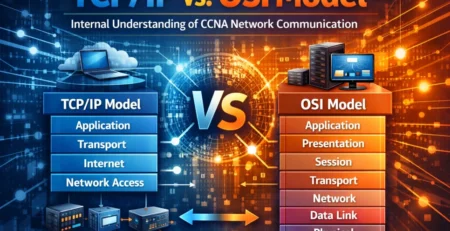
The most fundamental and efficient method for troubleshooting is to use the OSI model. A systematic progression from physical to application layers eliminates ambiguity. Meanwhile, individuals often apply switching or routing immediately when it’s only a cable or duplexing problem. However, this method is covered as a fundamental topic in the CCNA CCNP course and is even more essential in CCNP.
2. Clearly Defining the Problem
The initial step in the troubleshooting process is to understand exactly what the problem is. Furthermore, it becomes necessary to ask the user for details about symptoms, errors, and recent modifications. Unless the problem statement is clear, it becomes a matter of mere guesses for a production network.
3. Layered Troubleshooting with Documentation
All CCNP-certified engineers should understand the importance of documenting the network. Without the topology diagrams and IP addressing tables, a network becomes difficult to troubleshoot. The CCNP course qualifies students to implement documentation for identifying levels and troubleshooting.
4. Divide and Conquer
This method involves testing a network by segregating it into two segments. For instance, if there is a problem regarding end-to-end connectivity, one simply has to ping the middle device. Nonetheless, this method helps determine whether the problem lies in the source or the destination.
5. Baseline Comparison
It is vital to know how well or poorly an exemplary network can function. CPU utilization, memory, interface errors, and latency are all factors that need to be measured before. As soon as abnormal network behavior is identified, it becomes much easier to trace its cause by comparing it with benchmark measurements. Therefore, in the final stages of the CCNA CCNP course, benchmark analysis is imperative for real troubleshooting.
6. Knowledge Regarding Change Management
Most network problems are post-change issues related to recent events, such as an ACL change or a firmware update. Hence, it is vital to be aware of recent changes. The CCNP course certification teaches engineers to be disciplined, so they do not start troubleshooting changes without knowing how to roll back.
7. Command-Line Verification Skills
Executing show commands is only the starting point. Analyze the output of the show IP route command, the show spanning-tree command, or the show interface command. Additionally, experienced individuals at the CCNA CCNP course levels can easily interpret the output and identify the issue.
8. Hypothesis
Here, the engineer draws a logical inference and checks it. Furthermore, if the inference is not valid, a subsequent hypothesis is formed. It is similar to the scientific method and is much more efficient than the random experimentation used in the previous approach.
9. Use of Logs and Monitoring Tools
Syslogs, traps, NetFlow, and analytical tools show information not visible in networks. Moreover, network troubleshooting without using those tools is meaningless. Likewise, the advanced troubleshooting section in the CCNA Central Lab and CCNP Lab teaches how to relate log information to identify trends.
10. Root Cause Fix, Not Temporary Fix
The fourth and foremost technique is to resolve the root cause rather than simply treat the symptoms. Taking the issue of the interface flap, for instance, a temporary solution of shutdown and/or no shutdown will not be acceptable until it is properly rectified. It requires the ability of the CCNP course engineers.
Final Words!
As we all know, 70% of network issues are caused by Layer 1. We hope this comprehensive blog has provided you with the fundamental details regarding the advanced troubleshooting methods that every CCNA engineer should know after completing their CCNA CCNP course. Moreover, knowing how to use diagnostic tools and techniques prepares you for complex challenges. Likewise, these skills are paramount for keeping networks effective and performing seamlessly.
Remember that every issue you deal with while troubleshooting is an opportunity to grow and learn. Furthermore, embrace these problems and use them to understand network technologies in depth. At Rexton IT Solutions, our CCNP course provides valuable insights and support to sharpen your skills and ensure you are well prepared for both the certification exam and the demands of a professional network engineer. So, what are you waiting for? Enroll in our courses to start your successful IT career with a 100% placement guarantee.
Frequently Asked Questions
Here are the top five standard network problems that every CCNA engineer should know:
- Slow Network Issues
- IP Address Conflict
- Packet Loss Issues
- Wi-Fi Interference
- High Bandwidth Usage
Advanced network troubleshooting involves exploring and resolving issues in connectivity, security, performance, and other critical aspects of networks.
Expert-level troubleshooting skills allow CCNP-certified network engineers to troubleshoot some of the most complex real-world networking problems, including routing loops. All these networking troubleshooting problems are efficiently handled by network engineers who hold CCNP certification.
The OSI model enables a step-by-step approach to troubleshooting from the physical layer to the application layer. Thus, it allows CCNP professionals to quickly rule out difficulties and easily find solutions without neglecting physical connectivity malfunctions.
In fact, effective troubleshooting and analysis at the CCNP level involve using command-line verification with show commands, log analysis, and monitoring via Syslog and NetFlow, and hypothesis testing to determine corrective actions and implement a permanent solution rather than a temporary one.